
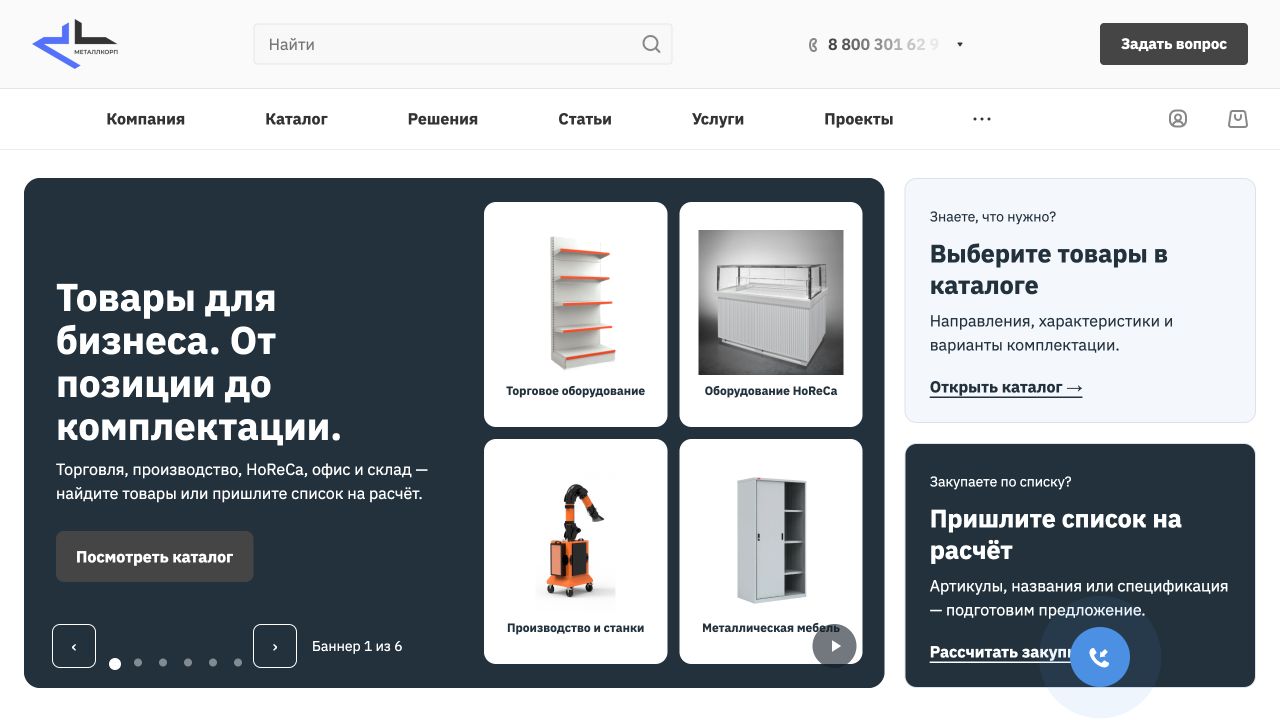
Visit the original project website (original language).
- Our role
- Rebuilding an existing website, integrations and technical support
- Project status
- Ongoing development
- Technology
- 1C-Bitrix · PHP · XML / YML / CSV · SEO
The task
Keep a large equipment catalogue up to date, combine different supplier data formats and help buyers choose equipment for their needs.
Vladislav Shishigin comprehensively rebuilt the existing Metallcorp website and continues its technical development.
Constraints
- Different supplier data formats
- Changes to prices and availability
- Equipment selection by technical specifications
What we built
- Importing and normalising supplier XML, YML and CSV data
- Improving the catalogue, product pages and filters
- Automating price and stock updates
- SEO structure and subject-specific landing pages
- Equipment calculators and selection forms
- Optimising images and mobile pages
How the system fits together
- SUPPLIER DATA
- PROCESSING
- CATALOGUE
- SELECTION
- ENQUIRY
What changed
- An equipment catalogue and pages addressing specific buying needs are available on the website
- Supplier data imports and catalogue updates have been configured
- Equipment selection tools and enquiry forms have been added
Project details
- 3 supplier data formats: XML, YML and CSV
- 6 areas of development: From the catalogue to selection tools
The system connects supplier data, the catalogue, stock levels, SEO pages, Avito and enquiry handling.
SEO for the Metallcorp catalogue: different pages for different buying tasks
An industrial equipment buyer may know the exact model, be looking for a suitable storage system, or first need to calculate warehouse capacity. A single catalogue category cannot answer all these questions equally well. At Metallcorp, we are developing several connected ways to choose equipment while retaining a shared source of products, prices and availability.
This work takes place within an operating 1C-Bitrix project. The catalogue continues to serve buyers, so each change is checked on selected pages and product sets. The account below covers specific work carried out in September and October 2026.
Keeping the catalogue focused on buying
A category page needs a product range, filters, prices and links to individual products. An equipment selection page serves a different purpose: explaining how the options differ and what information a quotation requires. A calculator helps someone who already wants to check a configuration themselves.
| Buyer task | Page | Next step |
|---|---|---|
| Compare products and prices | Catalogue category | Choose a model or variant |
| Choose a system for warehouse conditions | Solution page | Provide dimensions and operating conditions for a quotation |
| Check a calculation | Calculator | Save the parameters and send an enquiry |
For the SFM and STSM systems, we kept the commercial pages and self-service calculations at separate addresses. At the same time, we consolidated two versions of one calculator: the old URL redirects to the main one. The pallet-position planner remains a separate tool because it solves a different calculation task.
You can see this distinction on the SFM shelving solution page and the calculator for the same system. Separate URLs make sense when the pages give different answers. Copies of the same offer with a different heading do not belong in this structure.
Reviewing metadata before writing more content
The audit on 14 September covered 1,177 active sections. We found and fixed 36 incomplete sets of metadata. Nine sections were missing both a title and a description: the search page title and its short summary. Another 27 were missing a description. A repeat check found no remaining empty values in this class of defects. That is the result of a specific check, not a claim that the entire website is free of SEO issues.
We treated duplicate titles differently. First, we compared the category hierarchy and product selections. If a child category has its own range, an identical title alone is no reason to delete it or redirect it to its parent. We corrected inherited metadata for 111 such categories. Regional templates were reviewed separately.
Actual duplicates were consolidated with precise permanent redirects. Product URLs under the former paths were preserved. In the sample checked on 19 October, these redirects were still returning the expected 301 status.
Building new pages from the actual product range
For dunnage racks, we created a product-family page with a selection drawn from the catalogue. In another group, we separated chopping-board drying from dish drying: similar names concealed different buying needs. Prices on these pages come from the store's existing data.
Not every combination of features becomes a search landing page. A page needs its own demand, relevant products and a useful answer. We did not create an additional landing page for a narrow variant without sufficient evidence of demand. This limits the number of empty or nearly identical pages.
An example is the dunnage racks for food-service businesses page. Catalogue quantities change; a historical product sample must not be presented as current availability.
Keeping later catalogue pages accessible
Pagination displays subsequent parts of the range. If page two contains different products, automatically treating it as a copy of page one is inappropriate. We corrected a specific defect: actual results pages received their own canonical URL, which identifies the preferred address.
Sorting and utility parameters were reviewed separately from pagination. Acceptance checks covered server responses, headings, canonical tags and ordinary HTML links. Pages with different products retained a path for both buyers and search crawlers.
One tag does not replace a complete check. Google describes canonical URLs as a signal for selecting the main address. They should agree with links and other site signals; the search engine's handling of them must be checked separately.
Separating enquiry volume from SEO attribution
The owner estimates that the project now receives about 10 enquiries a day, compared with 3 to 4 previously. This was the owner's account on 19 October 2026. Comparable periods, enquiry composition and the contribution of individual channels have not yet been reconciled, so these figures are not presented as a proven increase caused specifically by SEO.
That assessment requires completed periods of equal length, organic search visits to the selected pages and confirmed enquiries. Tests, spam and repeated messages should be excluded. A click on a phone number or a calculation button does not itself confirm a new enquiry.
Measurement was also refined at calculator level: a successful submission was linked to a confirmed form result. A technical check of an event and the arrival of a real enquiry with a manager remain separate acceptance steps.
What another catalogue can use from this work
Start with one product group. Map search queries to the existing URLs, check product data and define the job of each page. Then agree on a limited set of changes and how to verify them after publication.
If you have a similar situation, see the scope of a technical SEO audit and our guide to preparing an online store for search. Use the catalogue review form to send your website address and one problem product group. We can use it to define a first verifiable stage without promising a predetermined number of enquiries.
Evidence and boundaries
- The public catalogue at металлкорп.рф
- Calculators and subject-specific website sections
- Working import scripts and a record of technical changes